Sleep, materials & informed choices
A Practical Guide to Finding an Organic Mattress Nearby
Searching for an organic mattress nearby can quickly turn into a maze of green labels, unfamiliar certifications and promises that sound more precise than they are. A useful search starts with better questions: Which parts of the mattress are organic? What does a certification actually verify? And will the bed suit the way you sleep?
For Kansas City shoppers, the process need not begin with a sales pitch—or end with the first showroom visit. A little preparation makes it easier to compare local options, examine the materials beneath the fabric and decide whether a mattress is a sound match for your comfort needs. The aim is not to find a bed with the most impressive vocabulary. It is to understand what you are considering, component by component.
First, make “organic” specific
“Organic mattress” is a useful search term, but it does not tell the whole story. A mattress is a layered object: its cover, quilting, comfort layers, support core, fire barrier, adhesives and finishing treatments may all involve different materials. A product description might refer to organic cotton in the cover while saying little about the foam or other components inside. Another may use natural materials without making an organic claim at all.
That distinction matters. “Natural” is a broad description, not a single certification. “Organic” can refer to agricultural production or to a particular material, but a claim about one component should not be read as proof that every part of the finished mattress is organic. Ask what the claim applies to, what it excludes and whether a certification independently verifies it.
Start by requesting a materials breakdown. Look for the cover fabric, quilting, comfort layers, core, fire barrier and any adhesives or coatings. If a retailer or manufacturer cannot explain a component, note the gap rather than filling it with assumptions. Clear, specific answers are more useful than a long list of attractive adjectives.
- Cover: Is it cotton, wool, a blend, or another textile? Is the organic claim attached to the fabric itself?
- Comfort layers: Are they latex, foam, fiber, wool or a combination? Ask for the material and the source of any organic claim.
- Support core: Is the mattress built around latex, springs, foam or another structure?
- Fire barrier: What material is used, and how does the manufacturer describe its role?
- Construction: Are the layers sewn, enclosed in a zippered casing, bonded or joined in another way?
Read certifications as evidence, not decoration
Certifications can help make an unfamiliar product easier to assess, but they are not interchangeable. Some apply to agricultural inputs, some to the processing of a specific material, and some address emissions or chemical testing. A mark is only informative when you know what it covers.
For organic latex, the Global Organic Latex Standard, commonly abbreviated GOLS, is one certification shoppers may encounter. It concerns organic latex and defined processing requirements. It does not, by itself, establish that every other part of the mattress—the cover, wool, stitching or any additional component—is organic. A separate standard may apply to organic textiles, and another may address indoor emissions. The exact scope depends on the certificate and the product.
Ask to see the certification name, the certified material or product, and the organization or certificate number when available. Then check whether the document is current and whether it refers to the mattress model you are evaluating, rather than a supplier or a different product in the same brand’s range. If a claim is important to your decision, verify it through the certifier’s own information where possible.
It is also worth separating a certification from a general statement such as “eco-friendly,” “clean,” “green” or “chemical-free.” Those words may describe a company’s intentions, but they do not identify a standard or explain what was tested. No mattress is literally free of chemicals: materials themselves are made of chemical substances. The more useful questions concern composition, processing, emissions and the evidence behind specific claims.
A quick claim-checking routine
- Identify the exact material the claim describes.
- Ask which independent standard or test supports it.
- Check whether the documentation applies to the specific model.
- Find out what the certification does not cover.
- Keep a copy of product specifications and warranty terms for comparison.
Understand the materials beneath the surface
Natural and organic mattress materials are not a guarantee of one particular feel. Latex, cotton and wool each behave differently, and construction can matter as much as the ingredient list.
Latex
Latex is used in mattress comfort and support layers. Depending on its formulation, firmness and thickness, it may feel buoyant and responsive rather than slow to recover. Some mattresses use a single latex layer; others combine layers of different firmness. Ask whether the latex is Dunlop or Talalay, whether it is certified organic, and whether the claim applies to the latex itself or to the complete mattress. Those details describe different things.
Cotton
Cotton commonly appears in mattress covers and quilting. It can provide a familiar textile surface, but the presence of cotton does not tell you whether it is organic, how it was processed or whether the complete cover has a certification. If these distinctions matter, request the relevant documentation and the percentage of each fiber in a blend.
Wool
Wool may be used in quilting or as part of a fire barrier. Its role, amount and sourcing vary by construction. Rather than assuming that “wool” means the same thing in every bed, ask where it is placed, what it is intended to do and whether the manufacturer has documentation for its sourcing or organic status.
Springs and other support systems
A mattress can combine natural textiles with metal coils or other structural materials. That does not automatically make it a poor choice; it simply makes a precise component list important. An organic claim should be evaluated in the context of the whole build, not inferred from one visible layer.
The central lesson is uncomplicated: compare specifications, not slogans. Two mattresses described as “natural” may have quite different materials, certificates, warranties and feel.
Decide what comfort means for you
A carefully documented mattress can still be the wrong mattress for a particular sleeper. Before searching for an organic mattress near you, make a short list of the physical and practical factors that shape your comfort. The list need not be technical. It should be honest.
Consider your usual sleep position. Side sleepers often notice pressure at the shoulder and hip; back sleepers may focus on whether the surface feels supportive without an uncomfortable hollow or hard spot. Stomach sleepers may prefer a surface that does not allow the midsection to sink excessively. These are starting points, not rules: body shape, personal preference and the mattress design all affect the result.
Think about firmness in terms of what you feel, rather than relying on a universal number. Firmness labels are not standardized across every maker. A “medium” in one collection may not feel like a “medium” in another. If you share a bed, ask whether the construction can accommodate different preferences on each side, and whether the available sizes and configurations actually support that arrangement.
Temperature is another practical consideration. Room conditions, bedding, sleepwear and individual physiology all influence whether someone feels warm at night. A breathable cover or a particular fill may be part of the discussion, but it is not a guarantee that a mattress will solve overheating. Ask about the complete construction and, if possible, test the mattress with the bedding you normally use.
Finally, consider your bed frame, room dimensions and preferred mattress height. A deeper mattress can change the height of the bed and affect fitted-sheet fit. Check the manufacturer’s foundation requirements, the weight and delivery conditions, and whether the frame is compatible with the design.
Use a showroom visit as a test, not a verdict
When a nearby retailer has a model on the floor, visiting can answer questions a product page cannot. It can also create pressure to decide quickly. Set a few boundaries before you go: bring your notes, ask to see the written specifications and remember that a brief test does not reproduce a full night’s sleep.
Lie down in your usual sleep position for several minutes. If you share the bed, test it together. Notice pressure points, whether you feel supported and whether changing position feels easy. Do not judge a mattress solely by its first impression; a plush top can feel inviting at first while the deeper support feels different, and a firmer surface can take more time to assess.
Ask the staff member to explain the construction plainly. Useful questions include:
- What are the exact materials in each layer?
- Which components are certified, and can I review the documentation?
- Is the mattress customizable, and what choices are available?
- What does the trial period require, and are there fees or conditions?
- What is covered by the warranty, and what is considered normal wear?
- How is the mattress delivered, set up and returned if it is not a fit?
- What foundation is required, and can the mattress be used on an adjustable base?
A credible answer may include limits. A salesperson who distinguishes a certified latex layer from an uncertified component is giving you more usable information than one who treats every sustainability phrase as proof of the same thing.
Search locally without assuming the listing tells the whole story
For Kansas City residents, “nearby” may mean different things depending on where you live, how far you are willing to travel and whether you want to test the exact model before ordering. Search by both the product category and the geography—terms such as “organic mattress Kansas City,” “organic latex mattress near me” or “mattress showroom Kansas City”—then confirm the details directly with the retailer.
Online listings can be useful for building a shortlist, but they may not show current floor models, delivery boundaries or the full certification paperwork. Call ahead and ask whether the precise mattress model is available to try. Confirm the store’s current address and hours through its own channels before making a trip. A showroom may carry one model from a collection while other configurations are available only by order.
Keep location separate from endorsement. A product’s presence on a website does not establish that it is displayed in a Kansas City showroom, in stock locally or available for immediate delivery. Verify those points rather than relying on an old listing, a broad brand page or the phrase “near you.”
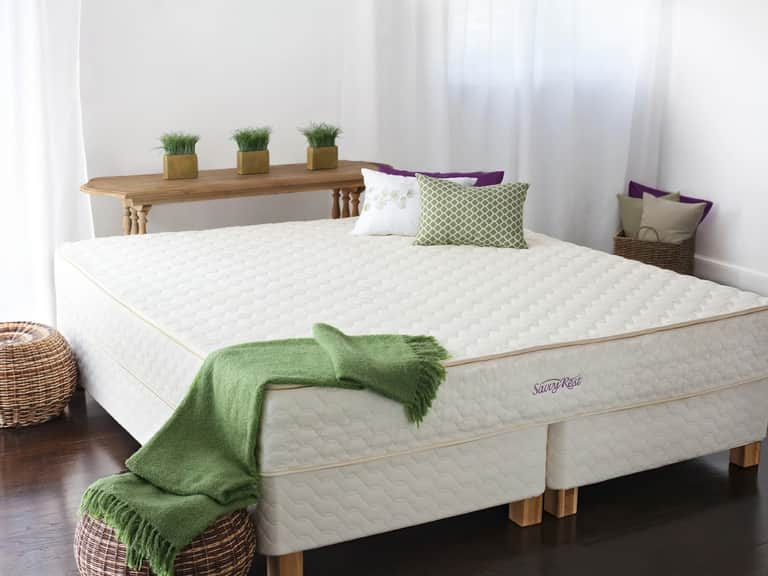
One example of a construction shoppers may encounter is the Savvy Rest Serenity Latex Mattress. Its listed design has three customizable latex layers, an organic cotton casing and organic wool quilting; the product information describes Dunlop and/or Talalay latex options and cites GOLS certification for the organic Dunlop latex. The certification claim should be understood as applying to the specified latex, not automatically to every mattress component. Availability, configurations and showroom access should be confirmed directly before planning a visit.
If a local showroom is not practical, ask about the return window, exchange policy, transportation costs, setup and any restrictions before ordering. A generous trial policy can reduce uncertainty, but only if its conditions are clear and workable for your household.
Compare the full cost and the care requirements
Price is one part of a mattress decision, not a measure of certification or long-term value by itself. Compare like with like: size, layer count, materials, customization, delivery, setup, foundation requirements, trial terms and warranty. A low advertised price may not include services you need; a higher one does not automatically mean the construction is better suited to you.
Ask how the mattress should be cleaned and protected. Some covers are removable but not machine washable; others should only be spot-cleaned. A mattress protector can help guard against spills and everyday wear, but check that it fits the mattress depth and does not undermine the feel you tested. A waterproof protector may be useful in some homes, yet its construction and fabric are separate from the mattress’s own material certifications.
Review the warranty carefully. It may cover specified defects or indentation beyond a defined threshold, while excluding ordinary changes in comfort, stains or damage caused by an unsuitable foundation. The trial period and warranty are different policies: one concerns whether the mattress suits you, the other addresses qualifying issues under stated terms. Save the paperwork and follow care instructions from the outset.
A decision framework you can take along
Once you have a few candidates, score each one against the same questions. A simple comparison prevents the most polished product description from taking over the decision.
| What to compare | What a useful answer includes |
|---|---|
| Materials | A component-by-component list, including cover, comfort layers, core and fire barrier. |
| Certifications | The standard, the material or product it covers, and documentation that matches the model. |
| Comfort | A chance to test the mattress, plus information on firmness options and customization. |
| Practical fit | Compatible foundation, dimensions, height, delivery arrangements and care requirements. |
| Risk and cost | Clear pricing, trial conditions, return costs, warranty exclusions and service terms. |
If a retailer cannot answer one of these questions, that is not necessarily proof of a bad product. It is a reason to pause, seek written information or compare another option. Transparency is part of the purchase, not an optional extra.
Common misconceptions to leave behind
“Organic” means the entire mattress is organic. Not necessarily. Check which components are certified and what the certificate covers.
“Natural” and “organic” mean the same thing. They do not. A natural material may not be organically certified, and a mattress may contain a mixture of certified and non-certified materials.
A certification guarantees the mattress will feel comfortable. Certifications address defined standards, not personal fit. Comfort still needs to be evaluated against your body, sleeping position and preferences.
A showroom test proves a mattress will work long term. It offers useful evidence, but a few minutes cannot recreate repeated nights at home. Trial terms and return logistics remain important.
One material is automatically best for everyone. Latex, wool, cotton, foam and coils each contribute differently. Construction, firmness and the combination of layers shape the experience.
The better search begins with better questions
Finding an organic mattress nearby is less about locating a perfect label than learning to read the one in front of you. Start with the materials. Verify the scope of certifications. Decide what support and comfort mean in your own bedroom. Then use a local showroom, when available, to test the exact model and clarify delivery, trial and care terms.
For Kansas City shoppers, the strongest choice may not be the bed with the most expansive environmental language or the nearest address. It is the mattress whose construction can be explained, whose claims can be checked and whose feel and practical terms make sense for the people who will sleep on it. That is a more modest promise than “perfect sleep”—and a more useful one.